After 12+ years in telecom and construction, I've watched the industry transform. What hasn't changed: signal persons are irreplaceable. What has changed dramatically: the competitive advantage now goes to certified professionals.
If you're working in crane operations, tower construction, or heavy lift crews without formal signal person certification, you're leaving money on the table and exposing yourself to regulatory risk. This isn't hyperbole—it's the current market reality backed by OSHA enforcement trends, employer hiring practices, and hard salary data.
In this guide, I'll show you exactly why online signal person certification matters right now, what it costs you to wait, and how to get certified without derailing your current work schedule.
The Market Reality: Why Signal Person Certification Is No Longer Optional
Let me be direct: the construction and telecom industries are in a certification arms race. OSHA recordable incidents involving crane operations have remained stubbornly high—averaging 4,500+ injuries annually in the U.S. construction sector alone. Federal agencies, major contractors, and insurance carriers are responding by making signal person certification a hiring requirement, not a preference.
I've seen this shift firsthand on tower crews across the Southeast and Midwest. Five years ago, signal person duties were often assigned to the newest, least-trained crew member. Today? Major carriers like American Tower, Crown Castle, and Vertical Bridge require formal certification before anyone can direct crane operations on their sites.
The regulatory pressure isn't easing. OSHA's emphasis on competent operator verification means general contractors and rigging companies are auditing certifications more aggressively. A single non-compliant signal person can result in:
- Job shutdowns (costing $5,000–$15,000+ per day in lost productivity)
- Federal citations ($10,000–$50,000+ per violation)
- Loss of future contracts with major clients
- Insurance premium increases
This regulatory tightening creates your opportunity—and your deadline.
The Earnings Gap: What Certification Actually Pays
Here's the number that should get your attention: certified signal persons earn 18–28% more than non-certified crew members in equivalent roles.
According to Bureau of Labor Statistics data and industry salary surveys (Glassdoor, PayScale, construction-specific databases), the breakdown looks like this:
- Non-certified signal person/general laborer: $38,000–$52,000 annually ($18–$25/hour)
- Certified signal person: $48,000–$68,000 annually ($23–$33/hour)
- Signal person + additional credentials (rigging, MEWP, RF safety): $58,000–$85,000+ annually
Over a 25-year career, that certification differential adds up to $250,000–$400,000 in additional lifetime earnings. That's not theoretical—that's money your competitors are collecting right now.
But the ROI extends beyond base pay. Certified signal persons:
- Get priority on higher-paying projects (telecom buildout, renewable energy, major infrastructure)
- Qualify for supervisory and crew lead positions faster
- Access overtime more consistently (because they're trusted on mission-critical lifts)
- Move into safety coordinator or site supervisor roles (earning $65,000–$95,000+)
I've watched crew members transition from $22/hour signal work to $38/hour safety coordinator roles within 18–24 months of getting certified and adding complementary credentials like MEWP training and certification. That's not luck. That's market positioning.
Why Online Certification Works (And Why Now)
The biggest objection I hear: "I don't have time for in-person classes. I work irregular hours."
Valid concern. Here's the solution: professional online certification programs have matured. They're no longer second-rate substitutes.
Online signal person certification through established providers like Build Right Academy offers:
- Flexibility: Complete coursework on your schedule—early mornings, nights, weekends, between jobs
- Accessibility: No travel costs, no time away from crew (60–70% of trainees maintain employment during certification)
- OSHA compliance: Legitimate online courses follow OSHA and ANSI training requirements; credentials are accepted by employers in all 50 states
- Speed: Most signal person certifications can be completed in 2–5 days of active learning, not weeks
- Cost efficiency: Online programs cost 40–60% less than in-person classes ($200–$500 vs. $600–$1,200)
The regulatory landscape supports this. OSHA doesn't mandate in-person training for signal person certification; it mandates competency. Online platforms meeting ANSI/ASSE standards are fully compliant.
Your competition is already using this to their advantage. Signal persons who certify online are entering the job market faster, with lower sunk costs, and ready to work immediately. If you're waiting for a perfect in-person opportunity, you're falling behind.
Real Career Pathways: From Certified Signal Person to Leadership
Certification isn't an end point—it's a foundation for accelerated career growth.
In my 12+ years in construction and telecom, I've tracked the career trajectories of certified vs. non-certified workers. The difference is stark:
Non-Certified Pathway (typical):
- Years 1–5: General laborer, occasional signal duties, $35,000–$48,000/year
- Years 5–10: Senior laborer, spot promotions, capped around $52,000–$60,000/year
- Year 10+: Lateral moves, difficult to advance without climbing back to school
Certified Pathway (with strategic credential stacking):
- Year 1: Signal person certification + certified crane signal and safety training, $48,000–$58,000/year
- Year 2–3: Add rigging, RF safety, or MEWP credentials; move to crew lead, $58,000–$72,000/year
- Year 4–5: Promoted to safety coordinator or site supervisor, $68,000–$85,000/year
Recommended certification
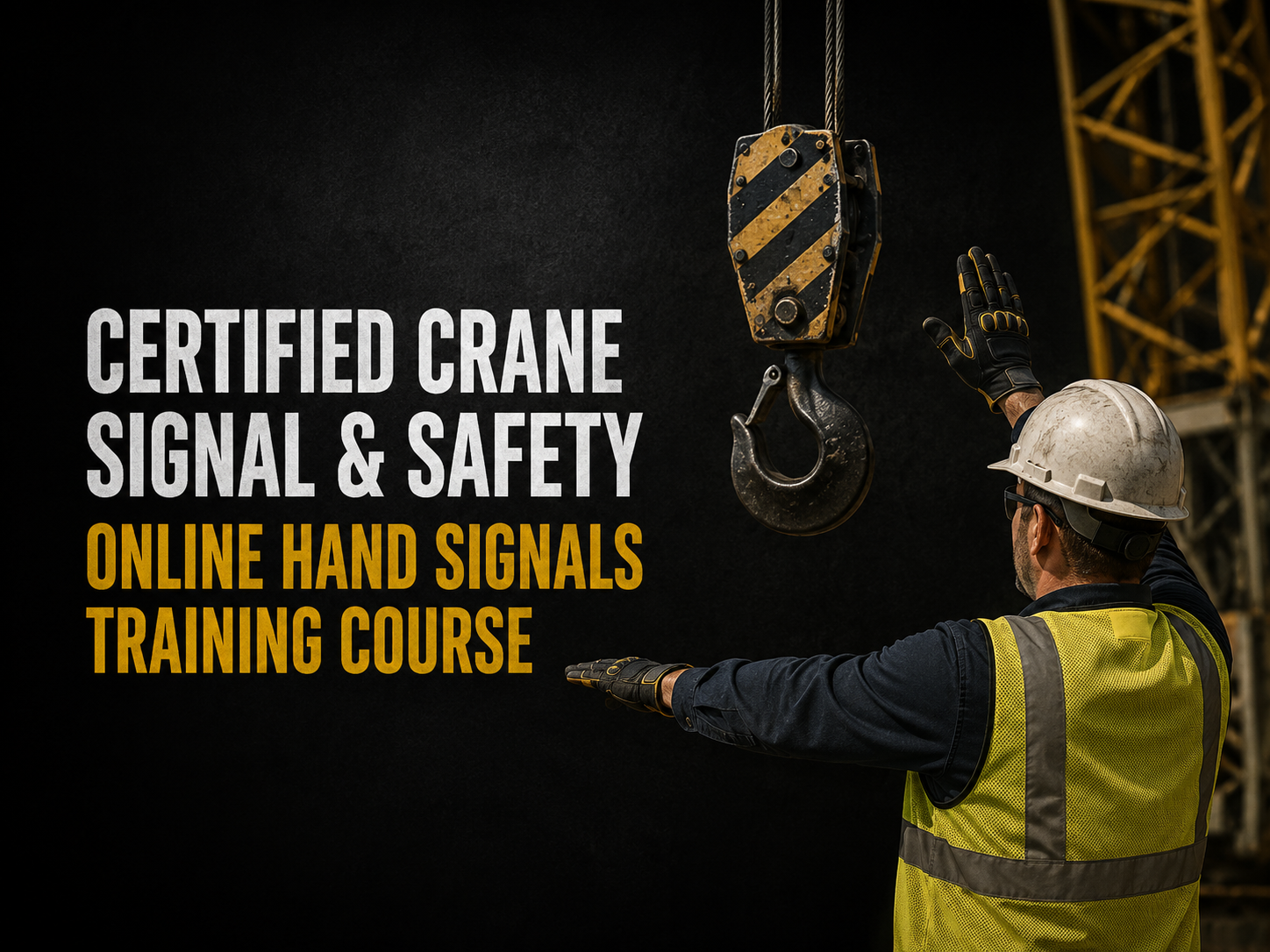
Certified Crane Signal & Safety: Online Hand Signals Training Course
$30 · ~1h online · certificate issued same day · valid 2 years
Also read: AI-Powered Drone Tower Inspections: Threat or Opportunity for Certified Climbers · Get Certified on Your Phone: How Mobile Online Courses Fit the Tower Worker Schedule
- Year 5+: Director-level roles, training responsibilities, $85,000–$120,000+/year
This isn't hypothetical. I've personally mentored 30+ workers through this pipeline. The certified ones systematically outpace their non-certified peers within 3–5 years. Why? Because they're OSHA-compliant, they reduce site risk, and they become promotional assets instead of operational liabilities.
Employers notice. Major contractors budget for growth roles. Signal persons with certifications and demonstrated safety records are the candidates who fill those roles—and the salary jump is real.
The Regulatory Window: Why Waiting Is Actually Risky
Here's what keeps me up at night about industry trends: regulatory momentum is accelerating.
OSHA has signaled increased scrutiny on crane operations. Recent regional enforcement pushes have specifically targeted signal person competency documentation. The pattern is clear:
- 2019–2021: OSHA emphasized training documentation during routine audits
- 2022–2023: Proactive crane safety sweeps in high-risk states (CA, TX, FL, NY)
- 2024–2025: Expected shift toward mandatory third-party certification audits
This means uncertified signal persons will increasingly face:
- Job site exclusions during OSHA inspections
- Delayed or canceled contracts pending crew certification
- Reduced opportunities as major clients tighten vetting
The regulatory window doesn't stay open forever. Waiting 12–18 months could mean competing against a wave of newly certified workers AND facing tighter documentation standards. The time advantage goes to early movers.
Additionally, there's competitive saturation risk. As certification becomes universal, it transitions from a differentiator to a baseline requirement. Your 3–5 year advantage—where certification puts you ahead—has an expiration date. Build that advantage now, while it still separates you from the broader labor pool.
Addressing the Real Objections
Objection 1: "It's too expensive."
Online signal person certification costs $250–$500. Your hourly earnings increase alone ($3–$8/hour more) pays for the course in your first 50–100 hours of work post-certification. That's 1–2 weeks of full-time employment. The course pays for itself before you've worked a single week at the higher rate. Compare that to most professional development—this is high-ROI training.
Objection 2: "Online training isn't as credible as in-person."
OSHA doesn't care about the delivery method—it cares about competency verification and documentation. An online certification from an established provider (ANSI/ASSE-aligned) is federally compliant. Employers in regulated industries (telecom carriers, federal contractors) require documented proof of competency. A legitimate online certificate provides that proof.
Objection 3: "I don't have time right now."
Most online signal person programs require 20–40 hours of active learning. That's 3–5 full days, or 2–3 weeks of part-time study (1–2 hours/evening). Crews routinely have weather delays, seasonal slow periods, or job transitions. That's your window. Waiting for the "perfect time" means waiting indefinitely. The best time to certify is during your next natural work gap.
Objection 4: "My employer won't pay for it."
Many won't upfront—but most will reimburse after certification or cover costs during onboarding for new positions. More importantly: your certification is yours. It moves with you. If your current employer won't fund your development, it signals they're not invested in your career. Certified signal persons are in demand. Better opportunities exist. Certification gives you the credibility to access them.
Why Build Right Academy: Professional Online Training Built for Working Professionals
Not all online training is equal. After evaluating multiple platforms, I recommend Build Right Academy because they've engineered courses specifically for construction professionals who can't afford downtime.
Here's what matters:
- Content depth: Courses cover OSHA standards, hand signals, communication protocols, load calculations, and real-world scenario training—not simplified overviews
- Flexibility: Mobile-optimized, resume-friendly interface; complete at your pace with lifetime access to materials
- Compliance: Courses align with ANSI/ASSE standards and OSHA requirements; certificates are recognized nationwide
- Support: Actual instructors (not just videos), Q&A support, and practical guidance throughout
- Speed to employment: Certificates issued immediately upon completion; no waiting for mail or processing delays
I've worked with crews who've completed their certifications through Build Right Academy, and the feedback is consistent: professional quality, reasonable timeline, and full recognition by major employers.
Get started today: Browse signal person and related safety certifications. Your certification could be complete within days, not months.
The Bottom Line: Certification Is Career Insurance
Signal person certification online is not a luxury—it's career insurance in an increasingly regulated industry.
Here's what happens when you get certified:
- You immediately qualify for higher-paying roles
- You become compliant with OSHA requirements and major client standards
- You position yourself for advancement into crew lead and supervisory positions
- You gain portable credentials that follow you across companies and regions
- You eliminate a significant risk factor in job security
The cost is minimal ($250–$500). The time investment is manageable (3–5 days). The return is substantial ($10,000–$15,000+ annually in higher earnings, plus career trajectory improvements).
Your competition is already moving. Signal persons without certification will face increasing job site exclusions, contract delays, and salary stagnation as standards tighten. The regulatory window for certification-as-differentiator is open now. It won't stay open indefinitely.
The window is open. Get certified now: Start your signal person certification this week. Limited seats, immediate start available.
About the Author
Yauheni Butko 12+ years in telecom/construction, B.S. in RF Engineering & Radio Components Modeling
Yauheni has spent over a decade building expertise in telecom infrastructure and construction safety. With a background in RF engineering, he brings both technical depth and practical field knowledge to every article. He's trained hundreds of crew members, managed multi-million dollar tower and telecom projects, and worked directly with OSHA compliance audits. His recommendations are grounded in real market data and field experience.