As 5G networks continue to expand across North America, tower technicians face new and serious RF (radiofrequency) safety challenges. Unlike previous generations of cellular technology, 5G infrastructure operates at higher power levels and different frequency bands, creating RF exposure risks that demand your immediate attention. Understanding these hazards isn't just about compliance—it's about protecting your health and your team's safety on every job site.
Whether you're new to tower work or an experienced technician transitioning to 5G sites, this guide covers the essential RF safety knowledge you need before your next climb.
Understanding RF Energy and 5G Technology
RF energy is invisible electromagnetic radiation used to transmit wireless signals. 5G networks operate across three frequency bands: low-band (below 1 GHz), mid-band (1-6 GHz), and high-band/millimeter wave (24-100 GHz). Each band presents different exposure characteristics.
The critical difference with 5G is power density. Modern 5G antennas concentrate energy in tighter beams with higher effective radiated power (ERP) than 4G LTE systems. This means standing in the wrong position relative to an active antenna can expose you to hazardous RF levels much faster than you might expect.
The FCC establishes occupational exposure limits of 50 microwatts per square centimeter (µW/cm²) for controlled environments where workers understand the hazard. The general public limit is 10 µW/cm². These aren't arbitrary numbers—they're based on decades of research into thermal and non-thermal RF effects.
Common RF Hazards on 5G Tower Sites
Antenna Radiation Patterns: 5G antennas have narrow, directional main lobes and side lobes. You might be safe standing to the side of an antenna but in immediate danger standing in front of it. Never assume an antenna is safe just because you can't see the RF—your eyes won't detect it.
Cumulative Exposure: RF safety isn't just about single incidents. Your exposure adds up throughout the day. Spending 20 minutes near a 5G array in the morning and another 30 minutes in the afternoon means cumulative RF dose. Track your time near energized equipment.
Multiple Simultaneous Systems: Most tower sites host multiple carriers with different frequencies and power levels. A site might have LTE, 5G mid-band, and 5G millimeter wave equipment all operating simultaneously. The total RF environment is the sum of all these sources.
Reflected Energy: Metal structures on towers, including cables, mounting hardware, and other antennas, can reflect RF energy. This creates complex field patterns where "safe" zones might exist just inches from hazardous areas. Don't rely on intuition—use proper measurement equipment.
RF Hazard Assessment: Your First Line of Defense
Before climbing any 5G tower, a qualified RF hazard assessment must be completed. This assessment should identify:
- All RF sources on the tower (frequencies, power levels, antenna patterns)
- Hazard areas where exposure exceeds safe limits
- Safe work areas and procedures
- Required PPE and monitoring equipment
As a technician, you should understand your site's hazard assessment and know where the exclusion zones are. If work requires entering a potential RF hazard area, controls must be in place: either de-energizing the transmitters or using RF monitoring equipment with trained personnel.
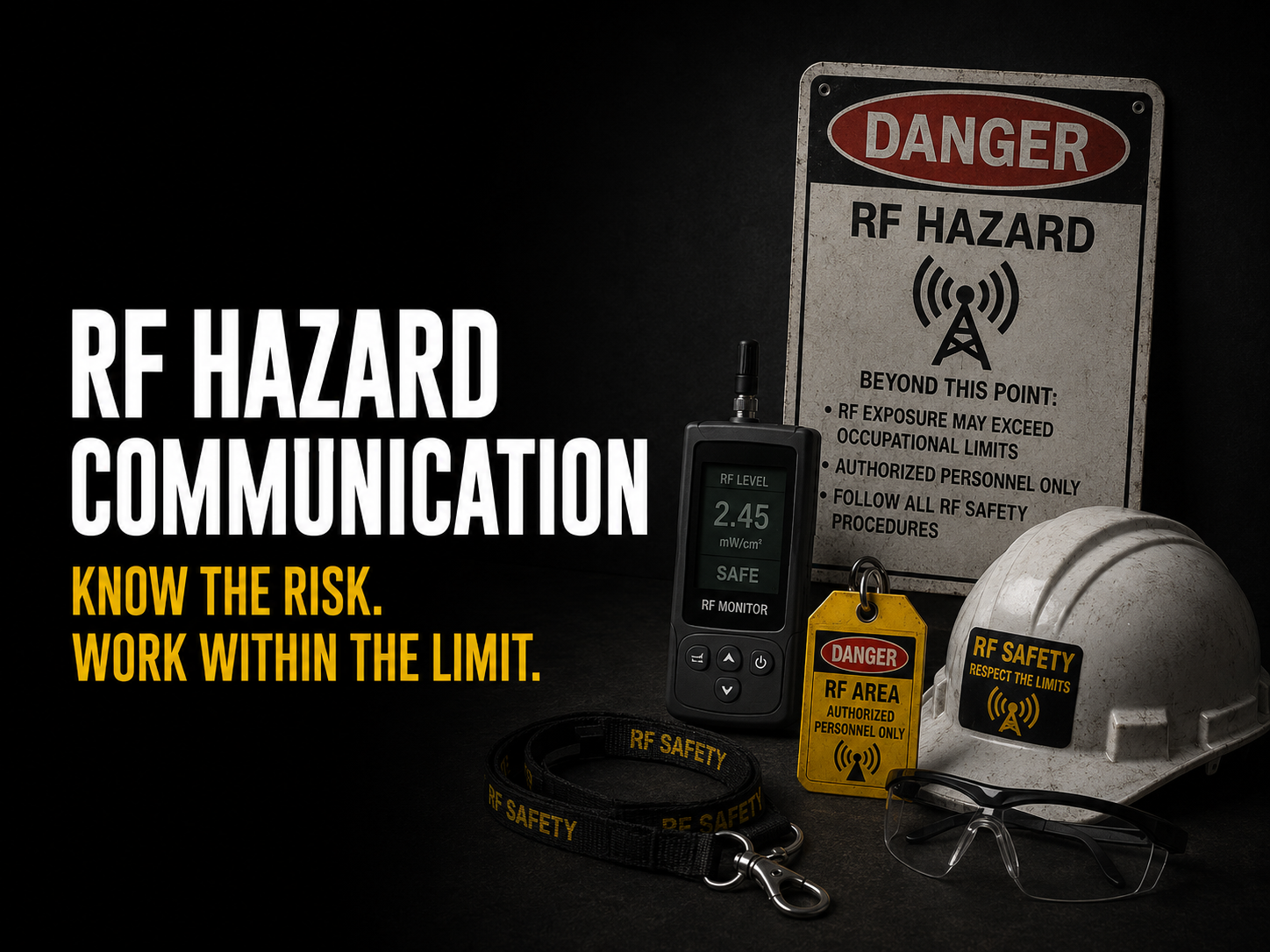
Many companies now use RF awareness signs and barriers. These are your first visual cues about hazard zones. Never bypass them without proper authorization and protective measures.
Practical RF Safety Procedures for Tower Technicians
Always Assume Equipment is Energized: Unless you've personally verified with a qualified RF engineer that transmitters are off, assume they're operational. Carrier systems can be activated remotely without warning on active sites.
Use RF Survey Meters Properly: If your company provides RF monitoring equipment, learn how to use it correctly. Different meters measure different frequency ranges. A meter that doesn't cover millimeter wave frequencies won't detect high-band 5G hazards. Know your equipment's specifications.
Plan Your Work Around RF Sources: Coordinate with site managers about transmitter schedules. Some sites can temporarily reduce power or redirect antennas during maintenance windows. This reduces your exposure significantly and should be part of your work plan.
Maintain Distance When Possible: RF exposure follows an inverse-square law—doubling your distance from a source reduces exposure to one-quarter. When you must work near antennas, position yourself as far away as practical. Even small distances matter.
Recommended certification
RF Awareness & Safety Training
$35 · ~1h online · certificate issued same day · valid 2 years
Also read: When the Market Falls, Bodies Follow: The Deadly Link Between Economic Downturns and Tower Climbing Deaths · Get Certified on Your Phone: How Mobile Online Courses Fit the Tower Worker Schedule
Minimize Time in Hazard Areas: Every second counts when you're in an RF field. Complete your work efficiently. Pre-stage your tools, plan your sequence, and avoid unnecessary time near energized antennas.
Communicate with Your Team: If you notice RF hazard signs or have concerns about a site's RF environment, speak up. Share information with coworkers about hazard areas and safe practices. Safety is a team responsibility.
Personal Protective Equipment and Monitoring
RF protective apparel exists but has limitations. RF-reflective clothing can reduce exposure in some scenarios, but it's not a substitute for proper hazard controls. It also creates a false sense of security and can actually concentrate fields near the body in some cases.
Personal RF monitors worn on your body are more useful. These devices alert you when you're entering or in an RF hazard zone, allowing real-time awareness of exposure levels. However, they require proper calibration and you must understand how to interpret their readings.
The most effective "PPE" is knowledge and proper work procedures—understanding the hazard, planning your work, and following established safety protocols.
Health Effects and Why This Matters
Excessive RF exposure can cause thermal effects (heating of body tissue) at high power levels. But occupational exposure limits also account for potential non-thermal biological effects observed at lower levels. Long-term cumulative exposure should be minimized whenever possible.
Tower technicians face repeated RF exposure throughout their careers. Protecting yourself now means healthier long-term outcomes. This isn't alarmism—it's occupational health best practice, the same principle that protects workers in other industries from cumulative hazards.
Getting Proper 5G RF Safety Training
Generic RF safety training isn't enough for 5G work. You need specific instruction on 5G technology, hazard assessment interpretation, and practical site procedures. Many companies require documented RF safety training before technicians work on 5G sites.
Quality training covers the science behind RF hazards, helps you interpret hazard assessments, teaches proper use of monitoring equipment, and walks through real-world scenarios you'll encounter on job sites.
Your Next Steps
5G deployment is accelerating, and sites with RF hazards will only become more common. Technicians who understand RF safety thoroughly are more valuable, safer, and more confident in their work. Taking the time to deepen your knowledge now positions you ahead in the industry.
Ready to develop comprehensive RF safety expertise for 5G work? Build Right Academy offers specialized telecom training courses covering RF safety, 5G technology, and tower technician skills. Our expert instructors combine real-world site experience with current industry standards to teach you what actually matters in the field.
Explore our complete course catalog and take your RF safety knowledge to the next level. Invest in your skills, protect your health, and advance your telecom career with Build Right Academy.
`
Related Courses at BuildRight Academy
Get certified online — training built to OSHA standards for construction and telecom workers:
- RF Awareness, Safety, and Hazard Training
Browse by category: